


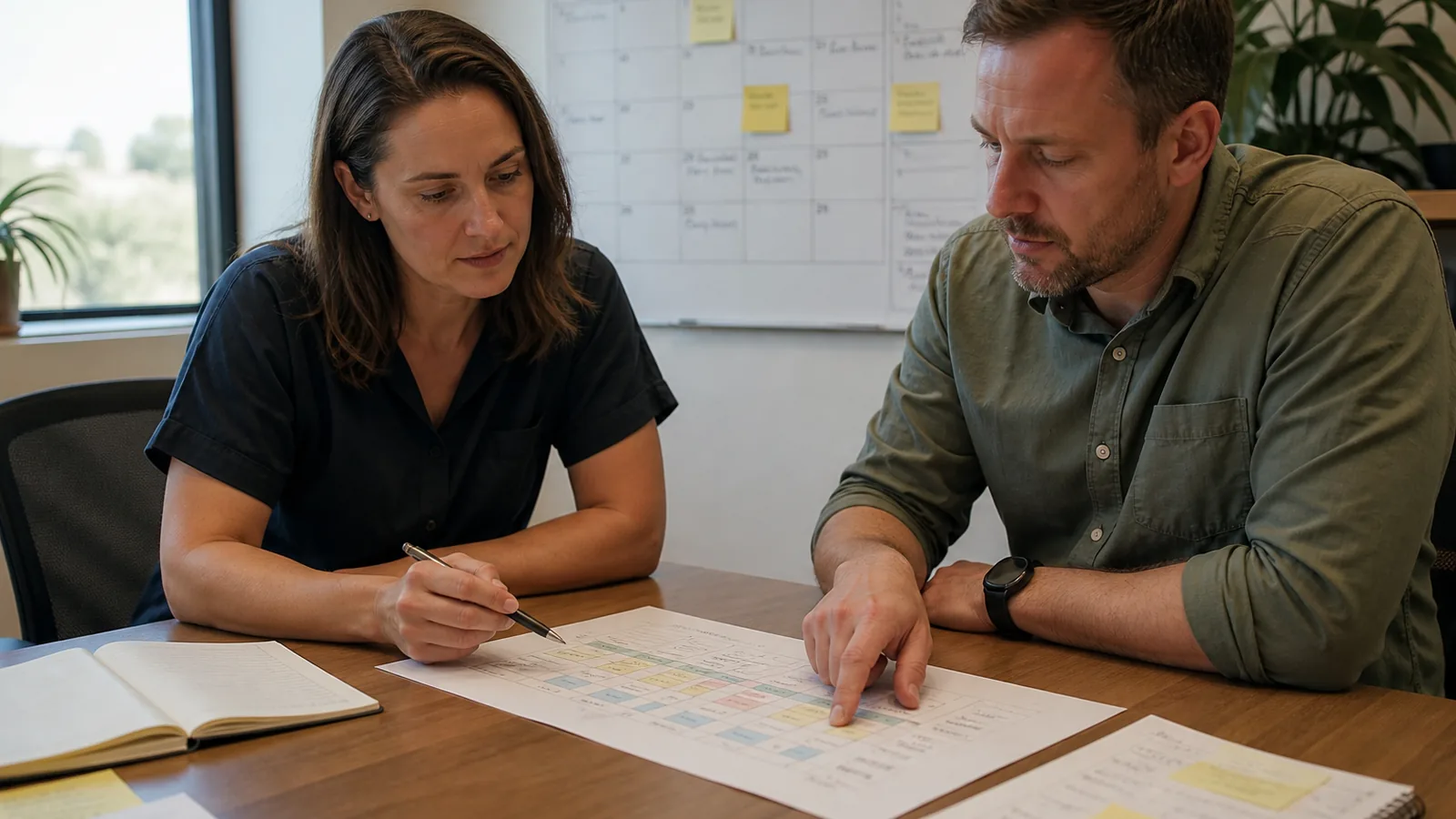
Choosing the Right Partner
A stalled software engagement costs more than unused development hours. Your product roadmap slips, staff repeat explanations and the business must decide whether to repair the relationship or start again.
For Australian businesses evaluating offshore development, this guide offers four practical checks: team continuity, accountability, relevant business understanding and AI governance. They are decision aids, not a validated model for predicting success. Price, technical capability, scope and commercial fit still matter.
The Right Questions to Ask
A portfolio shows what a provider has built. A rate card shows what it charges. Neither tells you exactly how your proposed team will work.
- Who will retain knowledge of your system, and what happens when someone leaves?
- Who owns product decisions, technical decisions, delivery and support?
- Can the engineers reason through your Australian operating context?
- Which AI tools may use your code or data, and how is their output checked?
Request evidence against a real workflow, then validate it through the proposed team, relevant references and the agreement.
Four Factors to Assess Before You Commit
The four checks below focus on risks that a feature list or capability presentation can leave unresolved. Apply them to every candidate, including Shinetech.
1. How Long Do Developers Actually Stay?
When an engineer leaves, undocumented business rules, design decisions and operational workarounds can leave with them. The impact depends on the system, documentation, team overlap and handover—not simply the replacement’s coding skill.
Company tenure is useful context, but it is not the same as time on your project. Nor does a developer’s total professional experience measure staff turnover. This guide does not use an industry-wide attrition or tenure benchmark because the sources reviewed do not establish a comparable one.
What to ask: Who is proposed for this engagement? How long have they worked on comparable systems? What are the replacement, overlap, documentation and handover arrangements, and who pays for them?
Shinetech’s published position: the company reports average developer tenure above eight years and 420+ partnerships lasting two years or more. These are company-reported indicators, not proof that an individual will stay on your project. Ask for relevant references and written continuity arrangements.
2. Who Actually Owns the Outcome?
A working feature is not necessarily the business outcome you needed. Accountability means someone can connect the requirement to the operating result, clarify missing decisions and resolve delivery issues.
Direct access to engineers can help resolve technical questions quickly. Product owners, project managers and business analysts can also add important expertise. The risk is an unclear or slow decision path—not the presence of a particular role.
What to ask: Identify the owners of prioritisation, architecture, acceptance, delivery and support. Ask which decisions the team can make, which need your approval, and how issues are escalated.
Shinetech’s published approach: How We Partner describes direct collaboration and business context before development. Confirm the named team, allocation and responsibility split for your engagement rather than inferring them from the model label.
A useful test is to give the proposed team one incomplete requirement. Look for the questions it asks, the assumptions it records and the decision owner it identifies—not just how quickly it offers an estimate.
3. Do They Know the Australian Market?
Relevant experience helps a team ask better questions about users, workflows, integrations and obligations. An Australian office or a healthcare logo does not, by itself, demonstrate that understanding.
For example, an ERP partner should be able to trace how your pricing and cost rules work; a care-platform team should distinguish the rule version and reporting period that apply. Experience in one regulated sector does not automatically transfer to another.
What to ask: Request a comparable workflow example and client reference. Then ask the proposed engineers to explain your scenario, separating known rules from assumptions that your business or specialist advisers must confirm.
Use our ERP and eCommerce business-rule test or aged care SaaS partner evaluation for concrete examples. For ownership and access questions, use the IP and data protection guide.
Shinetech reports 900+ Australian clients and work across several operational sectors. Treat that as company context; published case studies and relevant client discussions should establish whether the experience matches your project.
4. How Are They Using AI — and What Governs It?
“We use AI” is not evidence of either faster delivery or safe delivery. Ask what tasks the tools support and which controls apply to the code, requirements and business information they receive.
The team should define approved tools and accounts, permitted data, human review, testing and traceability. A security certificate can inform the review, but it does not automatically approve every AI tool or protect every workflow.
What to ask: Request one example with a defined task, baseline, review effort and quality checks. Do not turn time saved on a repetitive task into a promised percentage saving for the whole project.
What governed delivery looks like: engineers remain responsible for understanding the business rule, reviewing generated changes and proving behaviour. Shinetech’s published IP and data protection approach provides a starting point; confirm the AI-specific boundaries for your engagement.
Compare Evidence, Not Delivery-Model Labels
| Factor | Evidence to request from any provider | How to use it |
|---|---|---|
| Continuity | Proposed team, comparable project tenure, replacement and handover terms | Assess how knowledge is retained; do not compare unlike tenure statistics. |
| Accountability | Named product, technical, delivery and support owners | Test the decision and escalation path, including your responsibilities. |
| Business understanding | Worked scenario, relevant reference and explicit assumptions | Check the proposed team, not only the company portfolio. |
| AI governance | Approved tools, data rules, review and test evidence | Validate controls and any productivity claim for the actual work. |
These checks do not establish that one engagement model is always superior. Our comparison of eight providers serving Australian businesses describes different service models without ranking a universal winner.
Offshore Partner Evaluation Scorecard
Score each factor from 1 (unsupported) to 5 (specific, demonstrated and documented), and record the evidence. This is an internal comparison aid, not a validated predictor of delivery performance.
| Factor | Score (1–5) | Evidence / open questions |
|---|---|---|
| Team continuity and knowledge transfer | ||
| Accountability and decision-making | ||
| Relevant Australian business understanding | ||
| AI delivery controls |
Do not let a high total conceal a critical gap. Agree what must be demonstrated before commitment, who will resolve it and when. Validate references, scope and contract terms separately.
Questions to Ask Any Offshore Development Team Before Signing
- Continuity: who will work on the project, what comparable knowledge do they bring, and what happens if one person becomes unavailable?
- Accountability: who owns the outcome, which decisions can they make and how do we reach the engineers?
- Business fit: can the proposed team explain one of our difficult workflows and provide a relevant client reference?
- AI controls: which tools may access our information, who approves that access and what review evidence remains?
- Commercial fit: what is included, what do we supply, how are changes approved and how can we exit?
Frequently Asked Questions
Why can offshore software development partnerships stall?
Potential causes include loss of system knowledge, unclear decision ownership, incomplete business rules, poor scope alignment and weak delivery controls. This guide focuses on four practical checks; it does not establish their prevalence or rank them as universal causes.
What developer tenure benchmark should we use?
Ask for clearly defined company tenure, time on comparable projects and replacement arrangements. Total professional experience is not employee tenure or attrition. This guide does not claim a reliable industry-wide threshold; project-specific continuity and handover evidence matter more than an isolated average.
What should Australian SMEs look for in an offshore software partner?
Assess technical and business fit, continuity, accountability, security and AI controls, scope, costs and support. Use a real workflow and the proposed team to test claims, then validate relevant references and the agreement.
How does Shinetech approach offshore software partnerships?
Shinetech describes direct client-to-engineer collaboration, business context before development and long-term continuity. It reports Sydney and Melbourne offices, 900+ Australian clients, 420+ partnerships lasting at least two years and average developer tenure above eight years. These are company-reported indicators; verify suitability against the proposed team and engagement.
Choosing Well Matters More Than Choosing Fast
Choose a partner whose team, responsibilities and commercial approach fit the work—not simply one with a low rate or a strong scorecard total.
If you are evaluating Shinetech, bring one business-critical workflow and the constraints your team faces. We can discuss the proposed approach and the evidence you need before committing.
Discuss your project or explore the one-week free trial. Confirm the scope, access boundaries and expected outputs first.
Read what our clients say about working with Shinetech on Clutch.
Sources
- Shinetech — How We Partner
- Shinetech — published case studies
- Shinetech — IP and data protection
- Shinetech — company-reported client and continuity indicators
This article presents a practical evaluation framework, not an independent comparative study. Company metrics are self-reported; individual client reviews do not independently verify aggregate client or retention totals.