← Back to Case Studies

Case study · Business Software

Turning Security Incidents into Assigned, Traceable Response Work

A services organization needed one role-based workflow for reporting incidents, classifying them, assigning responders, and tracking work to resolution.

Security OperationsIncident Response.NETRole-Based Access
Turning Security Incidents into Assigned, Traceable Response Work
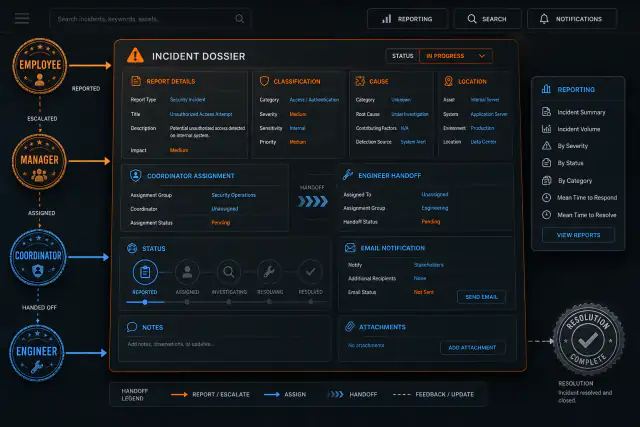
AI-generated or illustrative concept based on the case requirements. Actual client system not shown.
Industry
Business Software
Delivery
Dedicated team
Focus
Business outcomes

The situation

Incident details existed, but response depended on clear ownership and handoffs.

Employees needed to record what happened, where it was detected, its status, cause, and other operational details.

  • Managers, coordinators, and engineers then needed different permissions and actions as an incident moved from intake to classification, assignment, investigation, and closure.

Recognise this situation?

Create one workflow without giving every role the same view or responsibility.

Role boundaries

Employees, managers, coordinators, and engineers needed distinct actions and access.

Traceable handoffs

Classification and assignment had to stay connected to the original incident record.

Quality under load

The layered product required functional, integration, security, and load verification.

The project approach

A layered .NET product organized each incident as a role-aware response dossier.

The design connected intake data, classification, coordination, assignment, status, communications, search, and reports.

Collect the type, nature, cause, location, timing, and detection details needed for review.

How the solution was structured

Separate presentation, business behavior, and data access so the workflow could remain coherent.

  1. The application used layered design and an MVC approach to separate role-specific interfaces from business behavior and persistence.
  2. Role-based authentication controlled access, while the data layer supported transactions and object caching around the SQL Server database.
  3. Testing covered individual functions and components as well as security, integration, and load behavior.

Key information

Technology and delivery context

Industry
Business Software
Services
Custom Development · Dedicated Teams
Technologies and practices
Incident response · .NET · SQL Server · Role-based access
Business impact
Operational clarity · Delivery continuity · Usable software

The result

Reported incidents became assigned, searchable, and traceable response records.

  1. One incident context: Classification, assignment, communications, and resolution stayed attached to the originating record.
  2. Clear operational roles: Each participant could act within a defined responsibility instead of sharing one unrestricted interface.
  3. Tested architecture: Multiple test types supported the layered application's documented quality process.

Need a role-based workflow for complex incident response?

Tell us what you are trying to achieve and we will help you find a practical way forward.

Discuss Your Situation