← Back to E-commerce & Retail Case Studies

Case study · E-commerce & Retail

Turning Retail Operating Data into Role-Aware Business Intelligence

A retail operator needed to turn a large body of operating data into a consistent relational model and a usable library of role-aware management reports.

E-commerce and RetailBusiness IntelligenceASP.NET MVCSQL Server
Turning Retail Operating Data into Role-Aware Business Intelligence
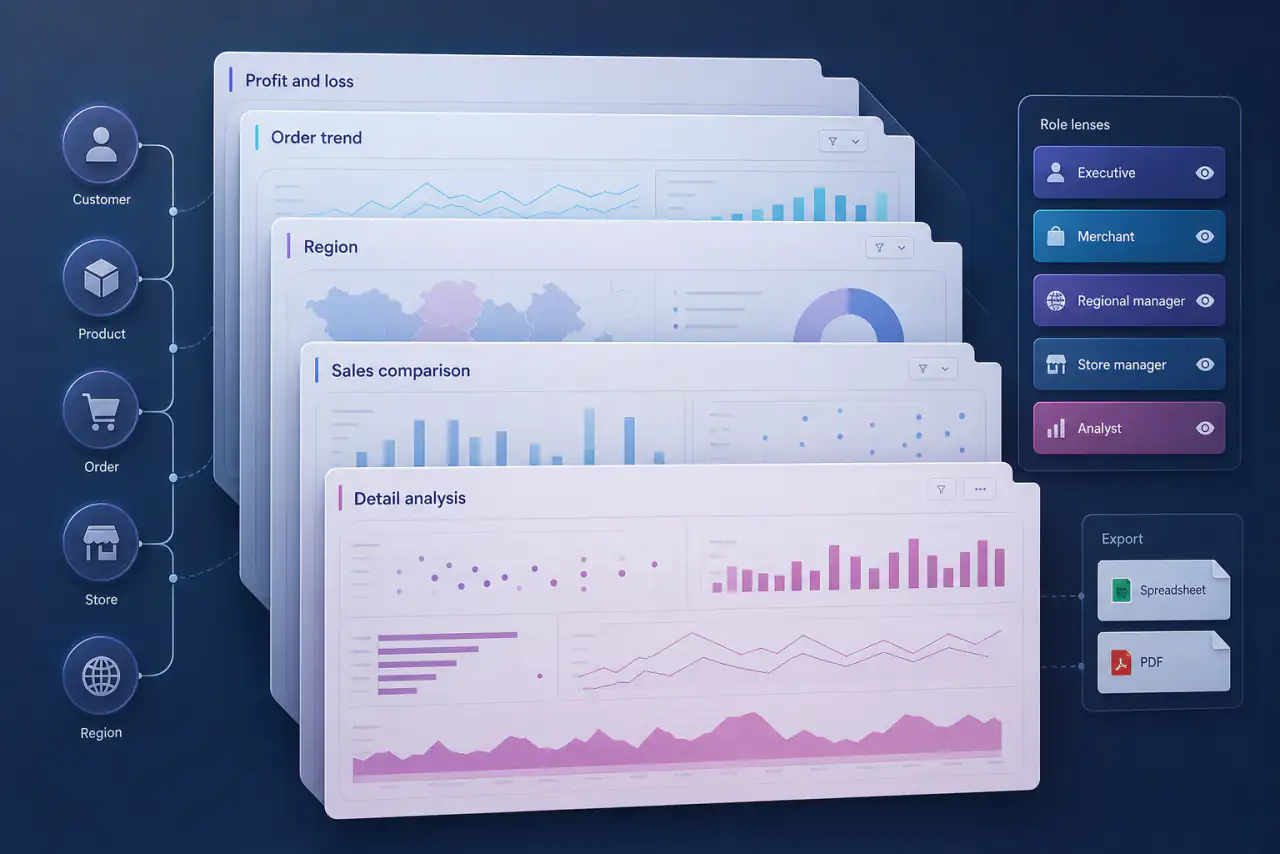
AI-generated or illustrative concept based on the case requirements. Actual client system not shown.
Industry
E-commerce & Retail
Delivery
Dedicated team
Focus
Business outcomes

The situation

The retailer had abundant operating data, but managers needed consistent business meaning and accessible reports.

Information from customers, products, orders, stores, regions, and other operating areas had to be brought into a model that could support shared calculations.

  • Different roles then needed reports for sales, order trends, regional comparison, profit and loss, detailed investigation, and broader management review.

Recognise this situation?

Turn data volume into a coherent reporting product rather than a collection of disconnected queries.

Business semantics

Source data had to be mapped into consistent entities, relationships, calculations, and reporting rules.


Many report needs

Management, finance, merchandising, regional, and operational roles viewed the business differently.

Usable access

Users needed interactive web reports, drill-down detail, and familiar export formats.

The project approach

A relational data model supported a broad, role-aware web reporting library.

The team combined business analysis, SQL Server modeling, calculation logic, and an ASP.NET MVC interface for management reporting.

Consolidate core retail entities and define relationships, calculations, and reusable measures.

How the solution was structured

Start with business meaning, then make the reports interactive.

  1. The team worked with stakeholders to understand existing data and the questions managers needed the product to answer.
  2. A relational model and calculation layer provided a shared foundation so related reports did not redefine the same business concepts differently.
  3. The web interface used ASP.NET MVC with jQuery and AJAX interactions, while SQL Server supported the underlying data and reporting logic.

Key information

Technology and delivery context

Industry
E-commerce & Retail
Services
Custom Development · Dedicated Teams
Technologies and practices
Business intelligence · ASP.NET MVC · SQL Server · Reporting
Business impact
Operational clarity · Delivery continuity · Usable software

The result

Retail operating data became a shared model and a role-aware management reporting product.

  1. Reports shared definitions: Related views could draw from the same modeled entities and business calculations.
  2. Managers could compare perspectives: Sales, order, region, financial, trend, and detail reports supported different operating questions.
  3. Access remained controlled: Role privileges determined which reports and functions were available to each user.

Need a reporting product built on consistent business definitions?

Turn operational data into useful decisions

Discuss Your Situation