← Back to Case Studies

Case study · Telecommunications

Standardizing Telecom Billing Data for Web Reporting

A telecommunications billing-analysis provider needed to ingest several carrier file formats, standardize their fields, and let customers review or export management reports through the web.

TelecommunicationsBilling AnalyticsSSISSSRS
Standardizing Telecom Billing Data for Web Reporting
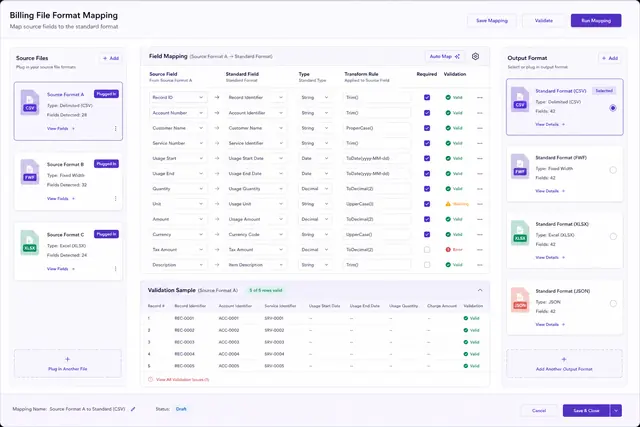
AI-generated or illustrative concept based on the case requirements. Actual client system not shown.
Industry
Telecommunications
Delivery
Dedicated team
Focus
Business outcomes

The situation

Monthly telecom insight depended on billing data that arrived in several incompatible formats.

The provider analyzed landline, mobile, voice, data, and paging charges for business customers. Management relied on a concise set of telecommunications performance indicators to spot areas that needed investigation.

  • Carrier data arrived as DBF, BIL, CSV, text, fixed-width DAT, and MDB files. Users needed a web system that could process those sources automatically, store standardized data, and make reports available for review or download.

Recognise this situation?

Standardize different carrier files without hiding mapping errors or report rules.

Format variation

Each carrier file structure required its own source-to-target field mapping and processing logic.


Management breadth

The web application needed upload, processing, report, client, configuration, and allocation controls.

Reliable reporting

Processed data had to support filters, totals, browser viewing, and several export formats.

The project approach

Format-specific SSIS packages fed a managed pipeline and SSRS reporting layer.

The team separated each billing format into a dedicated import package, then used a coordinating package, web services, and SQL Server jobs to run the appropriate workflow.

Define the field relationship between every carrier format and the standardized target data.

What we put in place

Separate source-specific parsing from the shared reporting model.

  1. Field mapping clarified what each billing file contained and how it should enter the common database.
  2. Dedicated subpackages isolated format rules, while a main package determined which processing path to invoke through web services and scheduled database work.
  3. Report behavior was built on standardized data access and business entities so filtering, totals, and export options could be applied consistently.

Key information

Technology and delivery context

Industry
Telecommunications
Services
Custom Development · Dedicated Teams
Technologies and practices
Java · XML · Data mapping · Web reporting
Business impact
Operational clarity · Delivery continuity · Usable software

The result

The architecture created a repeatable path from varied billing files to consistent web reports.

  1. Complexity stayed contained: A new or changed source format could be addressed in its own import package rather than rewriting the whole pipeline.
  2. Management functions stayed connected: Upload, processing, setup, generation, client, configuration, and allocation work shared the same system.
  3. Reports remained usable: Filters, totals, online review, and export choices supported different management needs.

Need a dependable reporting layer across inconsistent operational data?

Turn source variation into reporting clarity

Discuss Your Situation