← Back to Case Studies

Case study · Ingredient & Formulation Software / UK

Rebuilding an Ageing ERP Product When the Architecture Could No Longer Scale

A UK software company had sold an ERP product for years to ingredient and formulation businesses. Sales were still growing, but the product technology could no longer support the features needed to reach larger customers.

ERP Product RebuildJ2EEDedicated Product TeamLong-term Maintenance
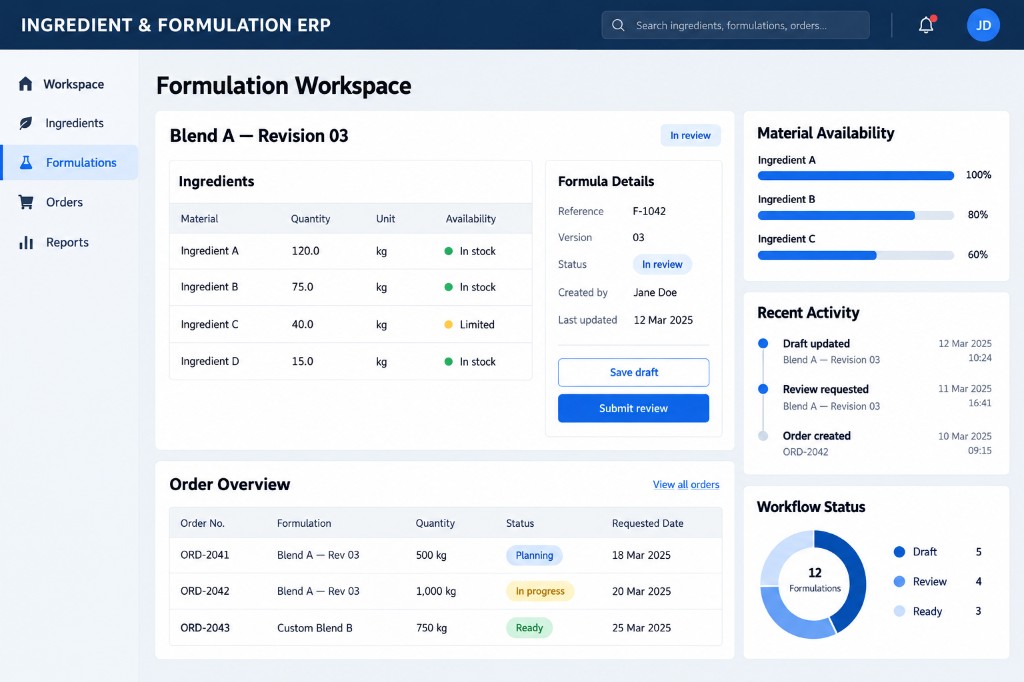
Illustrative ingredient and formulation ERP workspace showing blends, material availability and order overview
AI-generated concept interface with illustrative data. Actual client system not shown.
Team at peak
16 developers
Maintenance core
4 developers
Collaboration
From late 2006

The situation

The ERP still sold — but the architecture could not extend with the market

The client specialises in software product R&D for ingredient and formulation industries. It had been selling an ERP product for years. Although sales continued to grow, the product technology had become outdated, and the company planned to integrate more features to expand into larger-sized companies.

  • The existing product architecture was not adequate for further extension.
  • The client had a clear vision of the features required for the new product, but needed help with cost control, schedules and delivery capacity.
  • The work was not a short feature sprint — it required a new architecture that could preserve existing functionality while supporting new capabilities.

Recognise this situation?

Key Questions

Should we keep extending the old ERP, or rebuild the architecture?

The existing architecture could not support further extension. Shinetech rebuilt on a new foundation designed to carry current functionality and the next set of product features.


Can another team take on full product engineering for an ERP?

Shinetech acted as the client's IT / product engineering department across business modelling, requirements, implementation and ongoing support.

Can delivery scale without losing schedule and cost control?

The team grew from three to 16 developers in about half a year under a tailored RUP process, with transparent progress and iteration quality improvements.

The project approach

Rebuild the product foundation, then keep evolving it

Cooperation started in late 2006. Shinetech took responsibility for the full product development lifecycle — from business modelling and requirement definition through implementation and support — using J2EE and AJAX for the rebuilt ERP platform.

Project leadership customised the RUP methodology to the client's situation: simplifying document templates where standard RUP was too heavy, adjusting process as plans and team size changed, and allowing team members to cover multiple roles for cost effectiveness.

How the work unfolded

Earn trust, scale the team, ship a marketable ERP

  1. Spent the initial months analysing and documenting the client's business models so the team could contribute to planning, schedules, budget control and risk management — not only coding.
  2. Delivered iterations on schedule with continuous improvement in quality, while training new members on process, business context and responsibilities as the team expanded.
  3. Scaled from three to 16 developers within about six months through recruitment, training, ramp-up and plan adjustments managed as one coordinated delivery effort.
  4. After launch support continued: four key developers remained on maintenance and enhancement, and by June 2010 the client had won its first order for the new ERP product. The collaboration remained successful through 2020.

Key information

Technology and delivery context

Client
UK software company serving ingredient and formulation industries
Services
Custom development · Dedicated teams · Full product lifecycle ownership
Technologies and practices
J2EE · AJAX · Tailored RUP
Business impact
Product modernisation · Market expansion readiness · Long-term maintainability

The result

What changed for the client

  1. The ageing ERP product was rebuilt on an architecture able to support existing functionality and new features for larger customers.
  2. Shinetech operated as a reliable remote product engineering organisation — with predictable delivery, transparent status and a team that scaled with the roadmap.
  3. The rebuilt product reached market: the client secured its first order in 2010, while a core maintenance team continued enhancements for years afterward.

Is your ERP product architecture blocking the next market?

Tell us what the current product can no longer support, which workflows must be preserved, and whether you need a rebuild team that can grow with the roadmap.

Discuss Your Situation