← Back to Case Studies

Case study · Business Software

Protecting Identities in Project Email Workflows

A project-coordination company needed buyers and vendors to communicate through shared project threads without exposing either party’s real email address or losing the history behind each engagement.

Project CommunicationEmail WorkflowPrivacyPHP
Protecting Identities in Project Email Workflows
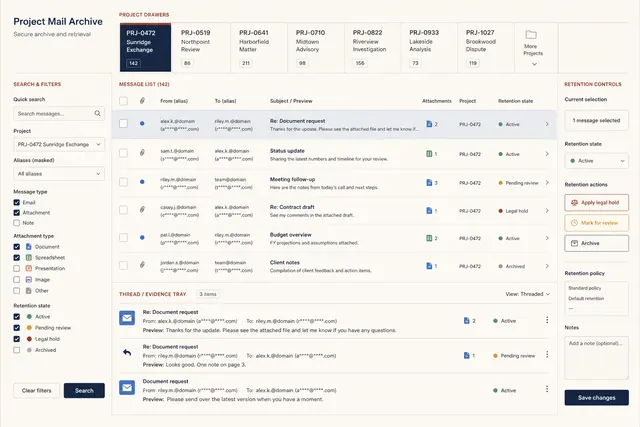
AI-generated or illustrative concept based on the case requirements. Actual client system not shown.
Industry
Business Software
Delivery
Dedicated team
Focus
Business outcomes

The situation

Project communication crossed three parties, but ordinary email exposed relationships and scattered the record.

The coordinator’s work depended on smooth communication among buyers, its own project team, and offshore vendors. Every message needed to remain connected to the right project so participants could understand the history and current status.

  • At the same time, buyers and vendors were not supposed to see one another’s real email addresses. The system needed to preserve privacy, define who could communicate on each project, and retain an auditable project-level archive.

Recognise this situation?

Preserve useful email behavior while adding identity protection and project context.

What needed to change?

A project-based relay masked personal addresses while preserving delivery, reply, archive, and retrieval workflows.


What did delivery need to protect?

Existing operations, data and stakeholder confidence.

What did a useful first release look like?

A practical workflow teams could use without waiting for a full rebuild.

The project approach

A web-based mail relay rewrote addresses, archived project copies, and enforced communication permissions.

Buyer and vendor addresses had to remain hidden from one another throughout the exchange.

Messages sent and received by different parties needed to remain visible as one chronological project conversation.

How the solution was structured

Model the communication relationships first, then make routing and archiving automatic.

  1. The team translated the three-party communication policy into a technical specification and structured the server around configurable rules.
  2. Address processing, project identification, archive copies, and permission checks were designed as parts of one message path.
  3. Testing was performed in the client’s server environment so mail behavior and configuration could be evaluated where the workflow would operate.

Key information

Technology and delivery context

Industry
Business Software
Services
Custom Development · Dedicated Teams
Technologies and practices
Java · SMTP/IMAP · Identity protection · Archiving
Business impact
Operational clarity · Delivery continuity · Usable software

The result

The coordinator received a private, project-centered record of buyer and vendor communication.

  1. Familiar communication: Participants could continue using email instead of learning an unrelated messaging product.
  2. Clearer project history: Archived copies kept the conversation associated with the project that produced it.
  3. Privacy built into routing: Identity protection was handled by the mail workflow rather than left to individual users.

Need to connect external parties without exposing relationships or losing context?

Tell us what you are trying to achieve and we will help you find a practical way forward.

Discuss Your Situation