← Back to Healthcare Case Studies

Case study · Aged Care, Healthcare

Moving Care Services from Excel to a Scalable Custom CRM

A care-services provider replaced Excel-based claims, invoices and participant records with a custom CRM MVP, then evolved it on AWS to support 30,000+ users across five companies.

.NET CoreAmazon ConnectASP.NET CoreAWSMicroservices
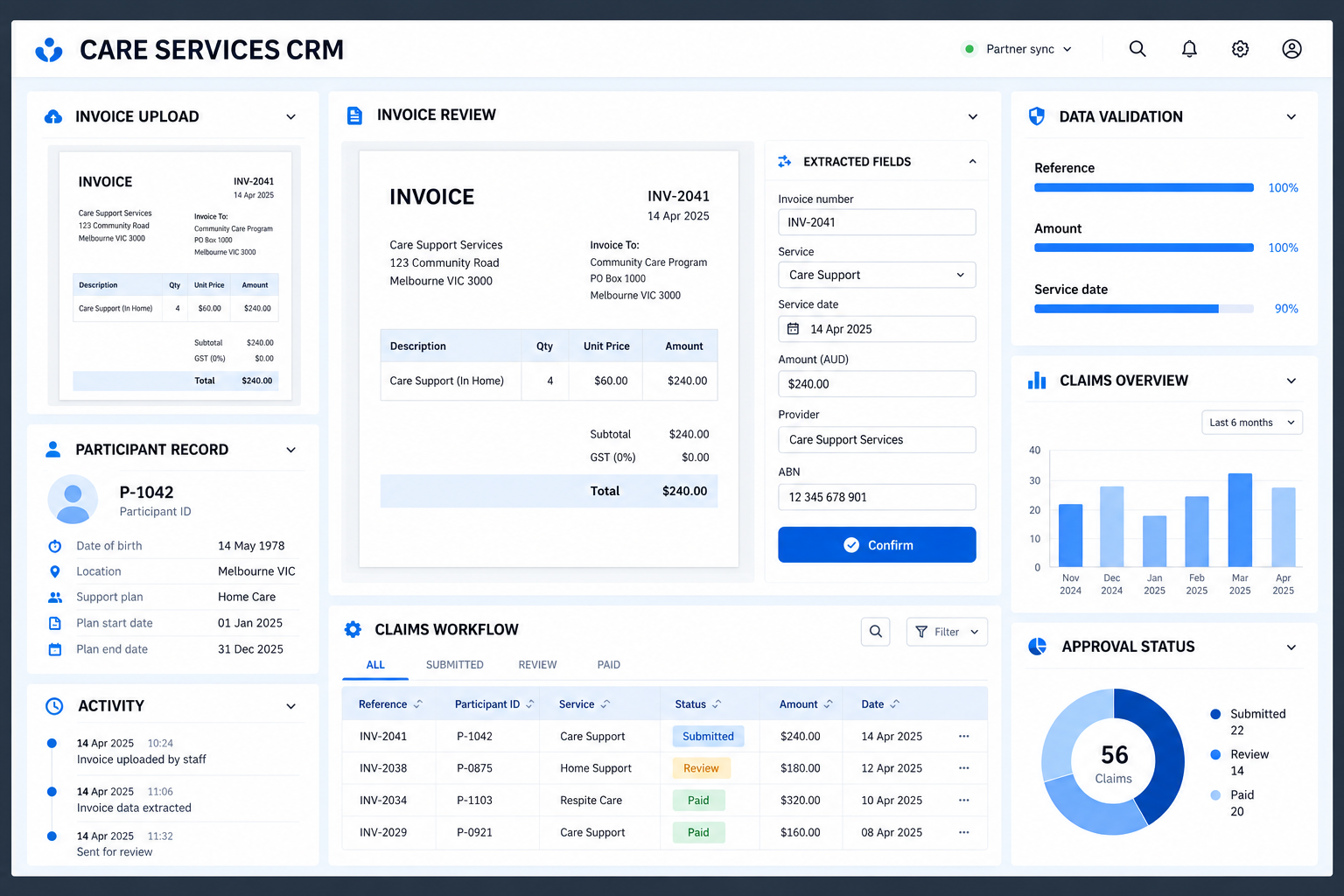
Illustrative care services CRM dashboard showing invoice review, participant records, claims workflow and approval status
AI-generated concept interface with illustrative data. Actual client system not shown.
MVP to launch
2 months
supported
30,000+ users
active partnership
7 years

The situation

When spreadsheets can no longer carry claims and care coordination

A newly established care services provider was managing invoices, claims, and patient data in Excel. They needed a purpose-built CRM to connect and manage data across vendors, partners, and official systems — and needed it fast.

  • The client was managing all invoices, customer information, and claims in Excel — an unsustainable approach as data volume and business complexity grew rapidly.
  • They needed a CRM system that could integrate with external systems and support efficient claims and reimbursement workflows from day one.
  • As the business scaled, the initial MVP faced serious scalability and compliance challenges that required continuous platform evolution.

Recognise this situation?

Key Questions

Can we replace Excel without waiting for a large CRM project?

A senior developer acted as Business Analyst and architect, defining requirements and leading three people to an MVP in just over two months.


Can the CRM connect claims, partners and customer information?

The purpose-built platform connected vendors, partners and official systems, supporting claims, reimbursements and service coordination.

What happens when the MVP needs to support a much larger business?

The engagement moved to a dedicated development model, with AWS automatic scaling, mobile access and continuing platform evolution.

The project approach

Deliver the first usable CRM, then evolve it with the business

The first requirement was a working CRM for a newly established provider. As data volumes and compliance demands grew, the team continued evolving the platform rather than treating the MVP as the end of delivery. Later work included AI-powered invoice processing and an Amazon Connect virtual agent system with CRM integration, call recording and voicemail.

An MVP CRM built in 2 months, then continuously evolved into a scalable, cloud-based platform with mobile access, AI automation, and virtual agent capabilities.

How the work unfolded

From a three-person MVP team to a dedicated development centre

  1. A Shinetech senior developer acted as BA and architect from day one — defining requirements, designing the solution, and leading a team of three to deliver the MVP in just over two months.
  2. Transitioned to a dedicated ODC model as the client scaled — migrating to AWS for automatic scaling, developing a mobile app, and integrating partner data with AI-powered invoice automation.
  3. Built a virtual online agent system on Amazon Connect to support remote work needs, with CRM integration, call recording, and voicemail capabilities.

Key information

Technology and delivery context

Industry
Aged Care, Healthcare
Services
Custom Development · Dedicated Teams
Technologies and practices
.NET Core · Amazon Connect · ASP.NET Core · AWS · Microservices
Business impact
Compliance · Performance · Scalability

The result

What changed for the client

  1. CRM platform now supports 30,000+ users across five companies, handling claims, reimbursements, and service coordination at scale.
  2. Team grew from 3 to 9 people over 6 years — 1 Product Owner, 6 Full Stack Developers, 1 Mobile Developer, 1 QA Specialist.
  3. AI-powered invoice scanning and data entry significantly reduced manual workload and boosted claims processing efficiency.
  4. Shinetech became the client's long-term development backbone, supporting their growth from a newly established startup to nearly 100 employees.

Are spreadsheets becoming a bottleneck in your care services?

Tell us how you manage claims, invoices and participant data today, which external systems need to connect, and what a first release needs to achieve.

Discuss Your Situation