← Back to Case Studies

Case study · Customer Service

Turning Contact-Center Workload Data into Faster Staffing Forecasts

A workforce-management software team partnered with Shinetech to turn proven statistical forecasting methods into a cloud application for contact-center workload and staffing planning.

Contact CentersWorkforce ManagementForecastingCloud Application
Turning Contact-Center Workload Data into Faster Staffing Forecasts
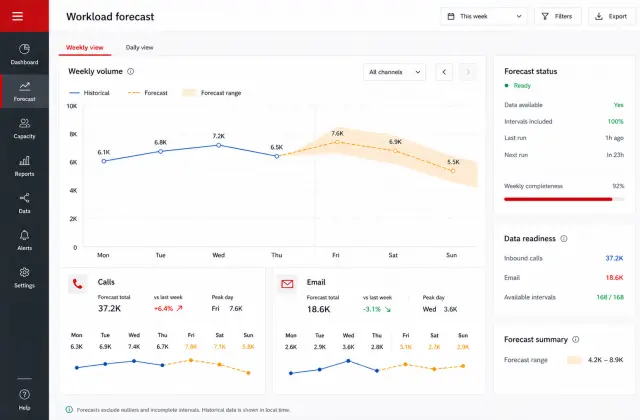
AI-generated or illustrative concept based on the case requirements. Actual client system not shown.
Industry
Customer Service
Delivery
Dedicated team
Focus
Business outcomes

The situation

Contact centers had the data to plan ahead, but forecasting remained slow and difficult to operationalize.

Customer-service organizations need to anticipate changing volumes across inbound calls, email, and other workload channels. Those forecasts directly influence how much capacity teams need at different times.

  • The client brought deep workforce-management expertise and proven statistical methods. The missing piece was a practical cloud product that could make those methods accessible without relying on time-consuming spreadsheet work.

Recognise this situation?

Turn specialized forecasting knowledge into software that operations teams could use confidently.

Model multiple workload channels

Organize inbound calls, email, and related operational data so statistical methods could produce useful workload forecasts.


Translate volume into staffing needs

Present forecast demand in a form that customer-service leaders could use when planning workforce capacity.

Move beyond spreadsheets

Replace a manual, hours-long process with a cloud workflow designed for repeatable use and broader availability.

The project approach

A cloud-based forecasting workflow connected operational data, algorithms, and staffing requirements.

Shinetech helped shape the product roadmap, select appropriate platforms, establish the hosting environment, and manage delivery from the initial design through working releases.

Structure workload inputs so calls, email, and time-based demand could be prepared consistently for forecasting.

How delivery was run

The roadmap, delivery process, and product architecture were shaped together.

  1. Shinetech introduced Agile and Scrum practices so both teams could turn the product concept into prioritized increments and review progress throughout development.
  2. Together, the teams created product roadmaps and a release sequence. Shinetech also supported technology selection, hosting setup, and day-to-day software delivery.
  3. This collaborative model gave the client visibility into decisions and created a foundation for continued product releases after the initial launch.

Key information

Technology and delivery context

Industry
Customer Service
Services
Custom Development · Dedicated Teams
Technologies and practices
SharePoint · Cloud application · Forecasting · Staffing planning
Business impact
Operational clarity · Delivery continuity · Usable software

The result

A globally accessible forecasting product that reduced planning time from hours to minutes.

  1. A usable path beyond spreadsheets: Forecast generation became a repeatable web workflow instead of a manual process assembled across separate files.
  2. Workload connected to capacity: The product linked incoming customer-service demand with the staffing requirements operations teams needed to plan.
  3. A foundation for continued releases: The client continued working with Shinetech to evolve the product after launch and highlighted the team’s communication, delivery speed, and work quality.

Need a cloud product that makes complex operational planning easier?

Tell us what you are trying to achieve and we will help you find a practical way forward.

Discuss Your Situation