



The Same Change, Two Very Different Bills
Four architecture checks for aged care SaaS teams preparing for the next regulatory change.
Consider two hypothetical platforms receiving the same revised quality-indicator definition. One has a controlled rule version, clear dependencies and regression tests. The other must find several copies of the logic and investigate whether past results have changed.
The difference is not the regulation. It is the work required to change the system safely. Architecture influences that effort alongside the scope of the change, data quality, documentation and team knowledge.
The Department’s QI Program Manual collection includes historical versions and a current November 2025 manual. Support at Home quality indicators have also been consulted on and piloted (consultation and pilot information). These are related but distinct programmes: do not treat residential requirements as final in-home specifications.
This article is for SaaS vendors and product and engineering leaders serving Australian aged care providers. It is software-design guidance, not instructions for providers on how to comply.
What You Can Build Before the Rules Are Final
You can prepare a platform for changing rules without pretending that unpublished implementation details are settled. Keep assumptions visible and avoid locking a provisional pilot definition into permanent product behaviour.
| Decision | Evidence and implication | Applies to |
|---|---|---|
| Prepare reusable foundations | Effective dates, eligibility models, validation and traceable calculations can support future definitions; validate the design when requirements are final. | Future in-home QI and other rule changes |
| Use the current residential material | The Department lists 14 residential indicators. Its manual collection now identifies a November 2025 current version; v4.0 took effect in April 2025 and is historical. | Residential QI reporting |
| Check conformance impact | The B2G guidance requires conformance before gateway connection; significant operational or data changes may require reassessment. | B2G-connected products |
| Do not infer a start date | The 2024 consultation said no earlier than 1 July 2026. That was not a confirmed commencement date. The cited implementation pages do not specify one at this review. | Support at Home QI |
Sources: QI programme overview, manual collection, B2G conformance guidance, 2024 consultation announcement and Support at Home consultation outcomes. Status checked 26 August 2026; confirm current Department guidance before planning a compliance release.
A pilot can inform product discovery. It does not establish the final mandatory set, submission format or implementation timetable.
A Compliance Feature Is Not a Compliance Capability
A compliance feature produces the required output today. A compliance capability lets the team understand and safely implement the next change.
The useful question is not whether your platform has reports and dashboards. It is whether a revised rule has one controlled definition, known consumers, a valid effective period and tests that protect previous results.
Four Architectural Factors That Shape Change Cost
The following four checks are a practitioner review framework, not a prescribed government architecture or a guarantee of lower cost.
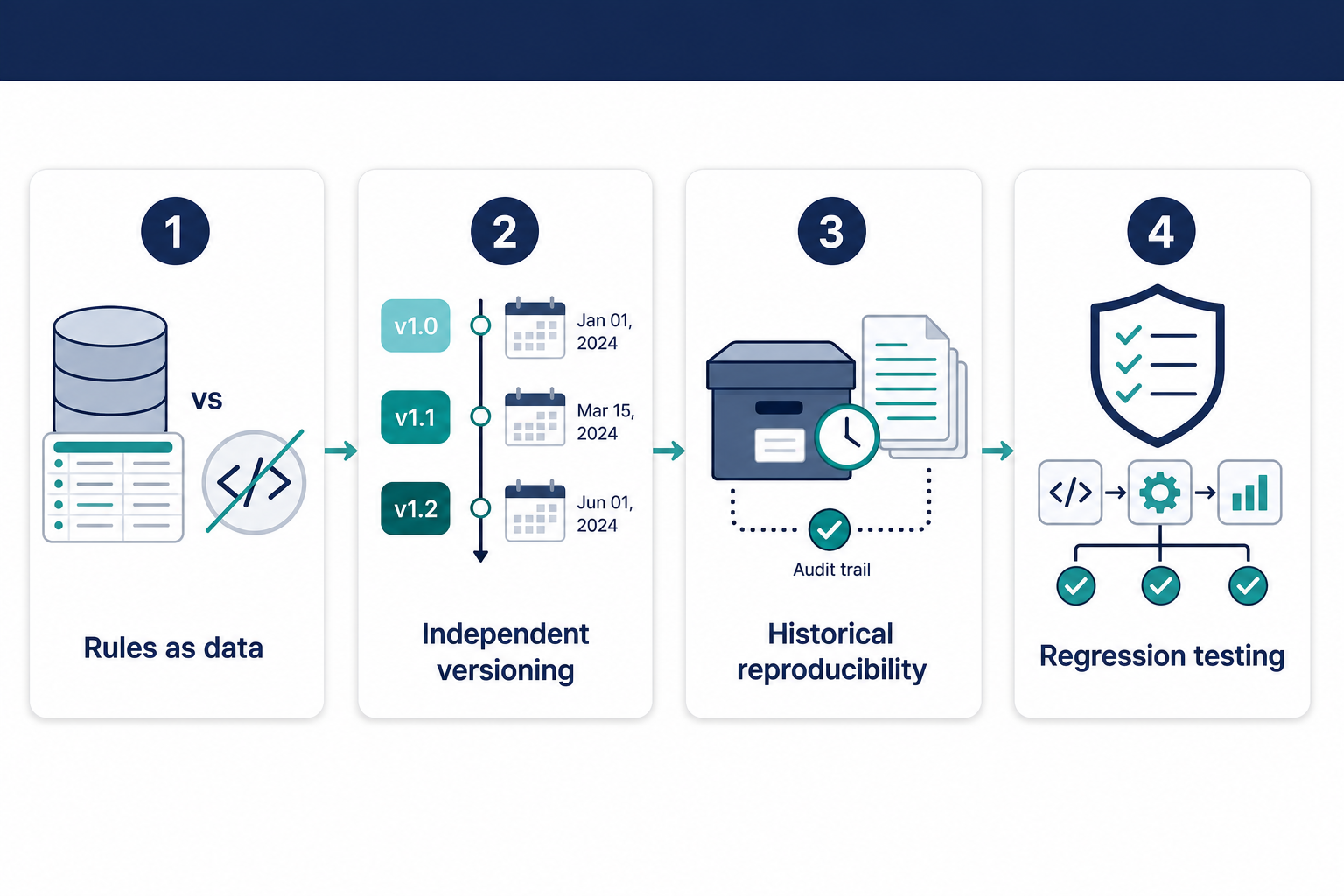
1. Can Rule Definitions Change Without Being Reimplemented?
Scattered, duplicated rule logic makes change harder to trace. A centrally defined rule—implemented in well-structured code or governed configuration—is easier to inspect and test than several inconsistent copies.
Configuration is useful for supported changes such as thresholds, effective dates and eligibility parameters. New calculation behaviour, workflows, schemas or integrations may still require code. A rules engine also needs validation, approval and release controls.
What to check: Change one representative definition. Where must it be edited, who approves it and how do calculation, validation and reporting consume the approved version?
Good evidence: one authoritative definition, documented dependencies and a controlled change path. Analyst-editable configuration is an option, not proof of safe architecture.
2. Can each part of a rule move on its own schedule?
Eligibility, calculation, exclusions and submission formats may change on different schedules. Model their versions and dependencies explicitly so the team knows which combinations are valid for a reporting period.
| Element that changes | Question to resolve |
|---|---|
| Eligibility or denominator | Which indicators and historical periods depend on this population definition? |
| Calculation or exclusions | Which expected results and edge cases change? |
| Submission format | Can the external contract change without unintentionally changing the business calculation? |
| Source data or provenance | Can the result still be traced to its inputs and transformations? |
What to check: Ask the team to show the compatible rule, calculation and output versions for one period. Separately versioned components must not be mixed arbitrarily.
Good evidence: effective dates, compatibility rules, dependency records and tests. A denominator revision may legitimately require a new indicator version; the goal is traceability and controlled impact, not avoiding every release.
3. Can a figure you already submitted still be reproduced?
The Department retains current and previous manuals so published QI data can be interpreted under the version that applied at the time (manual collection). Your product needs an equivalent explanation for its own results.
For a historical figure, retain or recover the applicable rule and indicator versions, eligibility criteria, source inputs, transformations and reporting period. If those records are missing, reconstruction may be difficult or impossible; it is not always impossible to recover them from existing archives.
What to check: Choose a prior submission and reproduce one figure using its applicable rules and input snapshot.
Good evidence: the original result remains traceable. If an error requires correction or resubmission, retain the original and corrected values, reason, approval and calculation basis rather than silently overwriting history.
4. Would you know if the last change broke something?
A rule change can affect collection, validation, calculation, dashboards and exports without creating a new screen. Test those dependencies as well as the changed definition.
For example, an incorrect standards-to-service mapping could produce an apparently completed audit containing the wrong questions. That is an illustrative failure mode, not a reported client incident. Waiting for a user complaint would be a weak detection plan.
What to check: Which tests cover applicable and excluded services, edge cases, downstream results and previously valid reporting periods? Who owns release evidence near a submission deadline?
Good evidence: controlled fixtures with expected results, historical regression where relevant, checks for invalid mappings and protected testing capacity. Configuration changes can have broad effects too; they do not justify testing only the edited field.
What This Costs, Either Way
| Change concern | Uncontrolled approach | Controlled approach |
|---|---|---|
| Where the rule lives | Duplicated logic with unclear ownership | Authoritative, versioned code or configuration |
| Who can change it | Informal edits or unclear approval | Authorised changes with a named rule owner and review |
| Historical results | Latest logic overwrites the explanation | Applicable versions and inputs remain traceable |
| Testing scope | Only the changed screen is checked | Dependency-based tests, including prior valid results where relevant |
| Release | Change impact discovered after deployment | Evidence, compatibility and rollback or repair decisions agreed first |
This comparison is about control, not “code bad, configuration good”. The value is reducing repeated investigation and avoidable rework while preserving correct behaviour. The amount saved is project-specific.
Score Your Own Platform
Rate each area from 1 (unproven) to 5 (demonstrated and documented). This is a planning aid, not a validated readiness score.
| Area | Evidence / gap |
|---|---|
| Authoritative rule definitions and controlled changes | |
| Effective dates, compatible versions and dependencies | |
| Historical results reproducible or corrections traceable | |
| Regression and release evidence matched to change impact |
Prioritise gaps by the consequence of failure and the next planned change. A high total cannot compensate for an untraceable submission or an untested critical rule, and no score guarantees a disruption-free release.
Frequently Asked Questions
How can an aged care SaaS platform handle changing requirements without rebuilding everything?
Keep rule definitions authoritative, versioned and effective-dated, with known consumers and regression tests. Use governed configuration for supported definition changes and code where behaviour or integrations require it. Both need impact analysis and release control.
Can historical quality-indicator data ever be recalculated?
Yes, where a correction or resubmission is required and authorised. Preserve the original result and the reason, rules, inputs and approval for the correction. Do not apply today’s rules to a past period without establishing that they are applicable.
When do quality indicators start for Support at Home?
At the 26 August 2026 review, the cited Department pages describe consultation and a pilot but do not specify a confirmed commencement date. The earlier statement “no earlier than 1 July 2026” was a lower bound, not a start date. Check current Department announcements before planning a mandatory release.
Should we prepare before final in-home requirements are published?
Prepare reusable foundations such as effective dates, eligibility modelling, traceability and controlled validation. Keep pilot-derived assumptions provisional. Final definitions, workflows and submission requirements may still require product changes.
When should a vendor seek additional engineering capability?
When regulatory changes, investigation or rework are displacing planned product delivery and the existing team cannot safely cover both. Assess relevant judgement, documentation, continuity and handover—not only hourly rate or whether the contract is short or long.
What Separates the Teams That Get This Right
Use one real platform change to assess the team. Ask it to explain a denominator, trace a historical result and identify affected outputs before proposing a fix.
The evidence is its investigation and release plan, not a claim of general healthcare experience. Our aged care SaaS engineering partner guide develops this into a bounded product-change assessment.
Build for the Next Change, Not the Current One
Do not estimate an unpublished regulatory expansion as a fixed number of sprints. First identify which parts of the platform are reusable, which assumptions remain provisional and which changes will need new behaviour or integration work.
If you are maintaining an Australian aged care SaaS product, discuss one upcoming change with Shinetech. We can agree the scope and access boundaries for reviewing rule ownership, historical traceability and release evidence.
Read what our clients say about working with Shinetech on Clutch.
Related reading: keeping aged care SaaS delivery predictable under reporting deadlines · evaluating an aged care SaaS engineering partner · why QI data can pass validation and still be wrong.
Sources
- Department of Health, Disability and Ageing — QI programme overview
- Department — current and historical QI Program Manuals
- Department — introducing quality indicators to Support at Home
- Department — aged care B2G and conformance
- Department — 2024 in-home QI consultation announcement
Regulatory status checked 26 August 2026. The architecture comparisons and scenarios are practitioner guidance, not government requirements, measured savings or reported client incidents. This article is not legal or aged care compliance advice.